
Kth Largest Element in a Stream
Microsoft Interview Question


Problem Overview
Difficulty: Easy
LeetCode Pattern: Heap
Implement a class named KthLargest that keeps track of test scores and always tells us the kth highest score after each new submission.
Original Input:
· k = 2
· nums = [2, 4, 5, 8]

add(1)
· Output = 5
· Reason: 2nd highest score is 5

add(9)
· Output = 8
· Reason: 2nd highest score is 8
Step 1: Clarify Requirements
Can k be negative or zero?
No.
Will the initial nums be sorted?
No, it won’t always be sorted.
Can there be duplicate values?
Yes, duplicates are allowed.
Step 2: Discuss Approaches
1/ Sort on Add (Suboptimal ⚠️)
Logic:
Append the new value to the list
Sort the list in ascending order
Return the value at index: len(list) - k
Big O:
Time Complexity: O(n·logn)
Space Complexity: O(n)
2/ Use Min-Heap (Optimal ✅)
Logic:
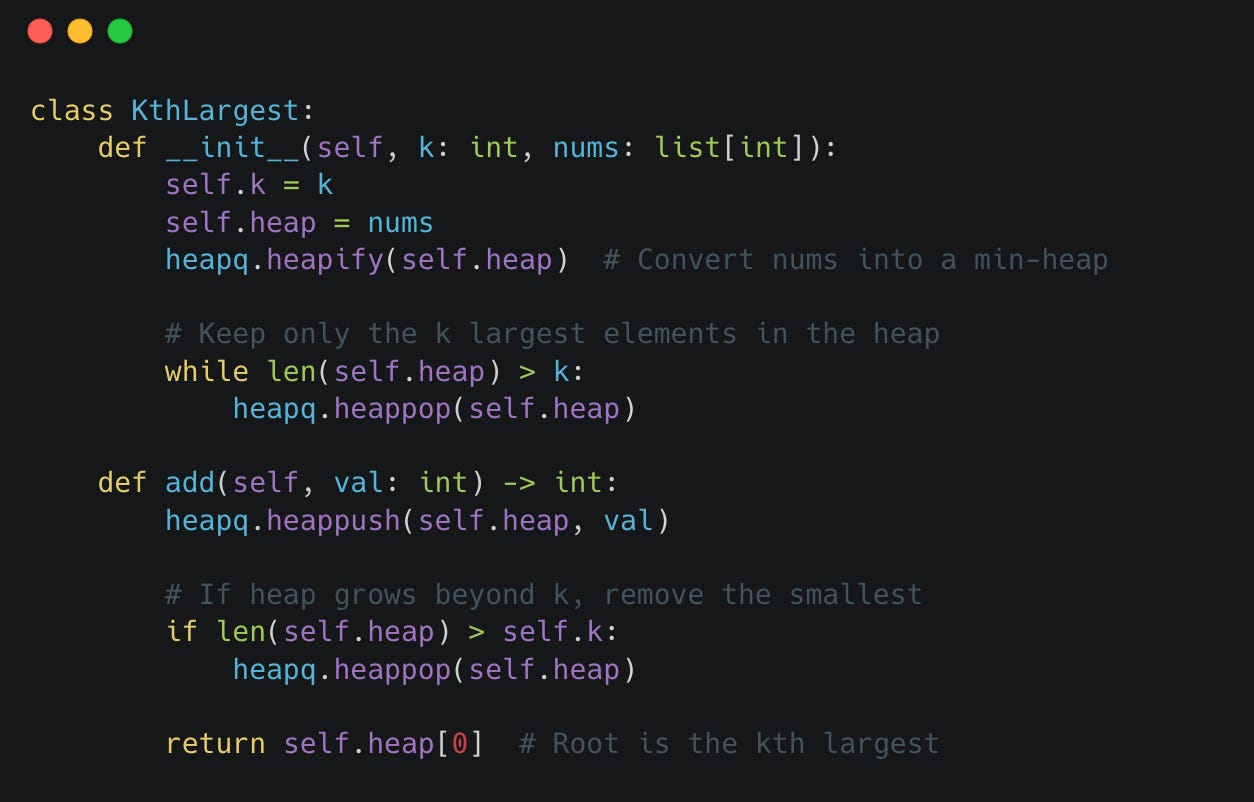
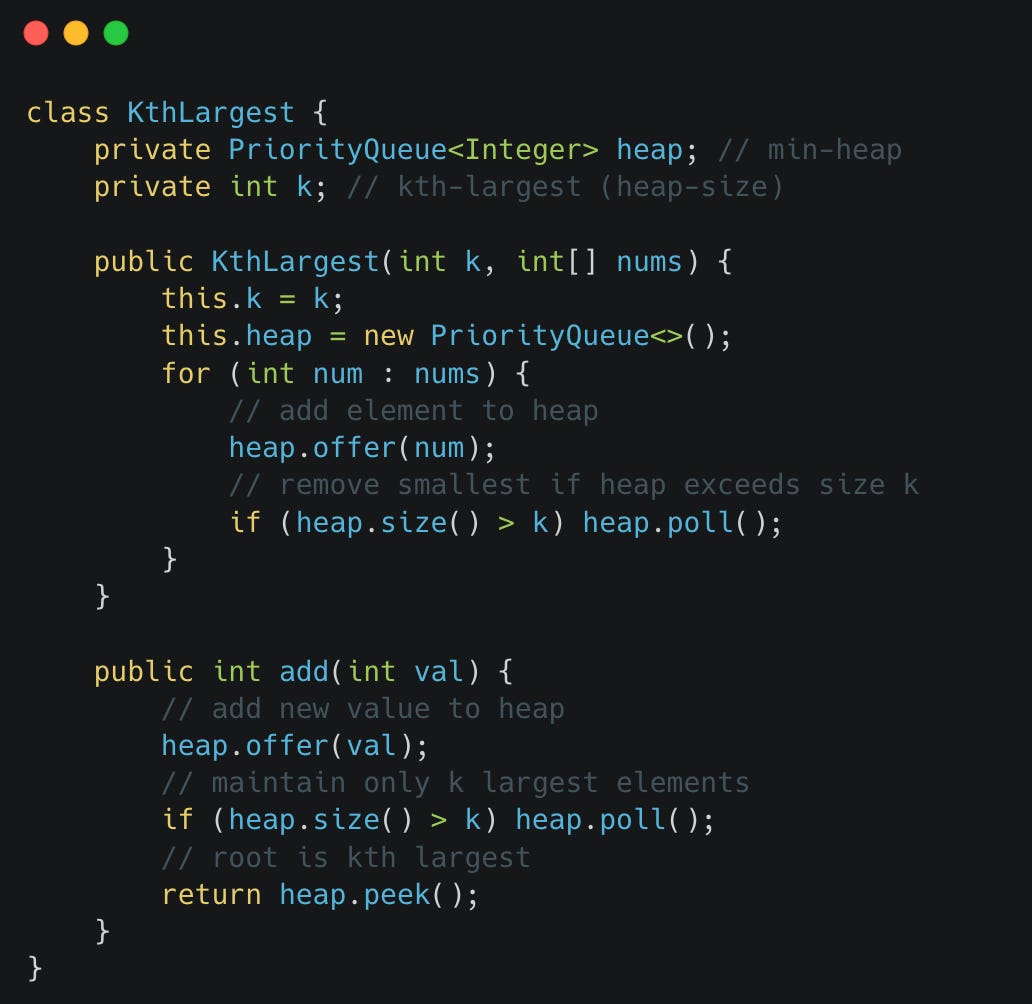
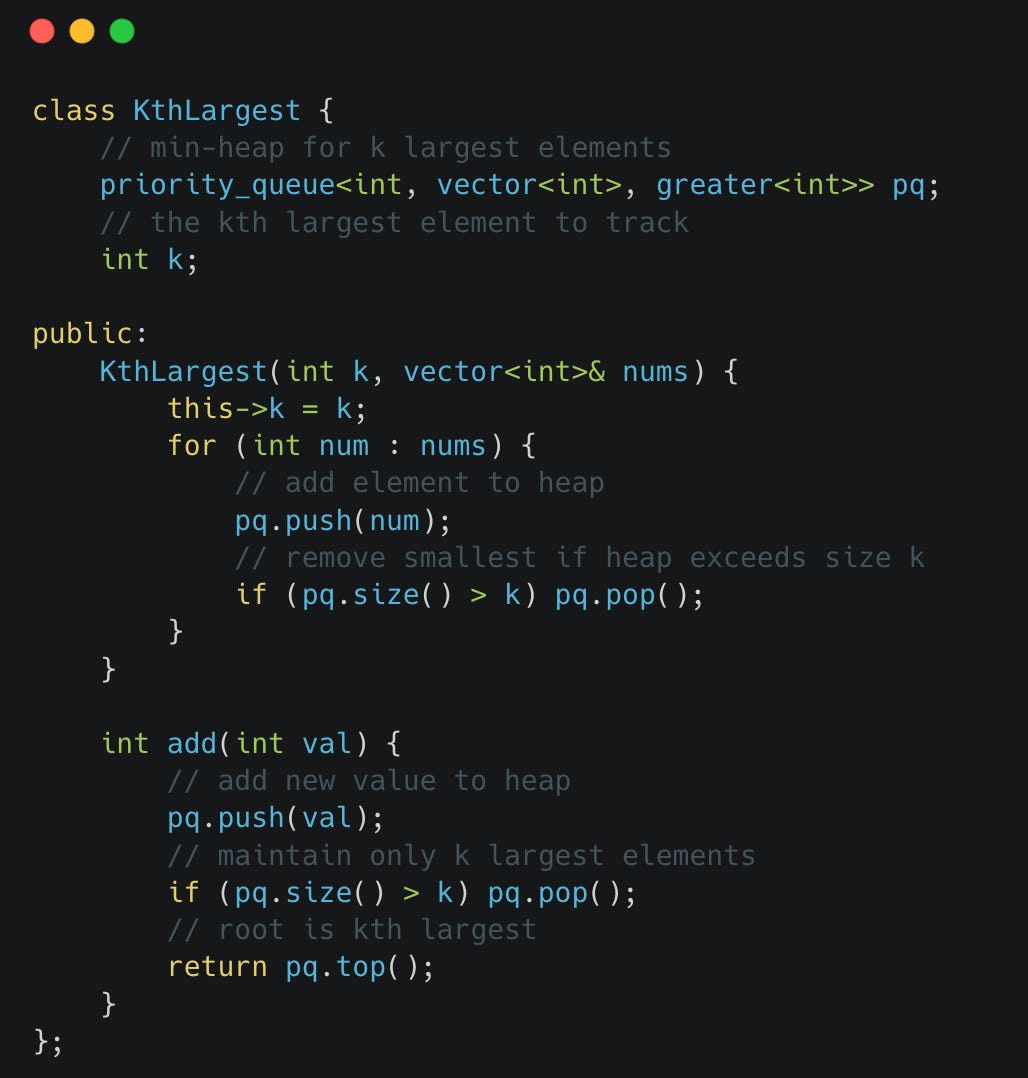
Use a min-heap of size k
Add the incoming value to this heap
If heap size > k:
Remove the smallest value
kth largest will be the top of heap
Big O:
Time Complexity: O(log k)
Space Complexity: O(k)
Step 3: Write Code (Optimal)
Python
Java
C++
Step 4: Answer Follow-Ups
What if the stream has duplicates?
Our solution still works.
What if n is large and k is close to n?
Eg: n is 1,000 and k = 999
Min-heap of size 999 is too big.
Instead, find (n-k+1)th smallest.
That’s 2nd smallest in this case.
So we create a max-heap of size 2.
Top of max-heap is the kth largest.
Great breakdown of the heap approach. The follow-up about switching to max-heap when k is close to n is clever, hadn't considere that optimization before. Ran into this exact problem in a mock interview last month and brute-forced it with sorting - wish I'd seen this explanation first.